Showing posts with label calculus. Show all posts

Monday, August 8, 2016

Get Them into Calc: A Defense of Calculus Education

I recently applied to be an AP Calculus Reader for (hopefully) next summer.  This has been a dream of mine for the past three years, so I was excited to finally be allowed to submit an application.

The application questions really got me thinking.  I realized (not for the first time) how passionate I am about calculus education.

A few months ago, I applied to begin a PhD in Mathematics Education, and I put these thoughts on paper for the first time. (I was accepted but deferred as I realized I couldn't stay away from teaching.)  Here's part of my essay for admission:

I fell in love with school from the moment I was first introduced to it.  I was the kid who would come home from school only to make her little sister pretend-play classroom until it was dinnertime.  Never was my sister allowed to be the teacher, by the way.  Being a teacher was all I ever remember wanting to be when I grew up.  [...] 
Not unexpectedly, one of the highlights of graduate school for me was teaching my own sections of College Algebra.  Because of this, I searched primarily for college teaching positions upon graduation.  I was pleased to accept a position at Tulsa Community College, teaching mostly for their EXCELerate program.  This meant that I had the privilege of teaching high school students at Union who were taking college classes for dual credit.  What I did not expect when I accepted this position was just how much I would love teaching high school students.  It should be noted that I attended only private school or homeschool through my childhood; hence, teaching at a large public school like Union High School was never on my radar.  Little did I know that I had just found one of my utmost passions in life.The following year, a position at UHS opened, and the administration asked me to apply.  With some trepidation, but mostly excitement, I accepted the position and began my journey as a high school teacher.  The past few years at UHS have been nothing short of incredible.  I accepted this job because I thought I could make a difference in the lives of young adults.  What I did not realize was what a profound impact these young adults would have on my life.  They have taught me the importance of kindness, vulnerability, patience, persistence, and love.  I adore my kids more than words can say, and I am forever in their debt for giving me a career about which I am truly passionate. My favorite class to teach is AP Calculus.  I feel this is a wonderful course that teaches so much more than mathematics.  Last year, I had an eighty-two percent pass rate on the AP Exam (one hundred percent pass rate for the students who had also had my PreCalculus course); the national pass rate was fifty-seven percent. [This year I had an eighty-seven percent pass rate; national pass rate was fifty-nine percent.]  Calculus education is a field that is somewhat under-researched, and I am excited to learn more about what can be done to promote calculus literacy and fluency at both the high school and the college level.  My goal in pursuing a PhD in Education is to one day be a teacher-leader at the district or state level to help schools vertically align their mathematics courses so that as many students who want to take calculus can do so and can experience success.  I have seen what experiencing this success can do for a child’s confidence.  I want as many students as possible to encounter this joy, and I want to help as many teachers as possible witness this.
That is my passion:  open access to calculus for all students who want to take it and who have taken the appropriate steps to acquire the necessary background knowledge.  I believe that access to calculus is vital for a school's success because a school's primary goal should be to see its students grow.  My claim is that advanced mathematics allows students this opportunity.  When students experience success in calculus, their view of themselves blossoms.  They start to see themselves as young adults who are capable of basically anything...if they will work and stick with it.  I've seen it time and time again in just a few years--calculus gives kids confidence they never had before.

Yes, calculus allows students to navigate both abstract and applied mathematics.  If done right, it teaches them how to see the world through derivatives and integrals.  It teaches them about the physics of motion and about the science of change.

But, it teaches them in many other ways...

For better or for worse, calculus is seen to many as the pinnacle of mathematics education, maybe even the pinnacle of all high school education.

I'm not saying this is right.  But I have taken advantage of this.

When the majority of my students start calculus class, they come in with a mixture of anxiety and excitement.  They've reached a point many do not reach.  They are both proud of themselves and also scared of failure.  If they fail, what does that say about them?

What I believe is vital is that--if they show up and if they try--they will not fail.

In fact, they will succeed.

And when they succeed, they soar.  Sure, they've done well in other classes before, but something unique happens when they do well in calculus.  Again, part of this is due to the way our culture glorifies calculus; but part of this is due to the fact that you really cannot BS your way through calc.  You have to know it.  You have to understand it; to apply it.

Hence, when students achieve that passing grade (ethically), they know they earned it.  They know they mastered the material.

My point is:  I believe we have to do more to (1) get more students into a high school calculus course and (2) get those students to succeed in calculus.  Because when these kids succeed in calculus, they decide they are capable of just about anything.

It's our job as educators to push our kids to greatness.  We have to believe they are capable of more than they believe they're capable of.  We have to demand more of them than they would demand of themselves.  We have to give them the tools to conquer their goals and their fears.

Get them into calculus.  It will accomplish all of this.

Sunday, May 8, 2016

Rate In/Rate Out Review

The AP Exam is over! This year, I reviewed my kids very similarly as I did last year (each week we focused on a new multiple choice and free response topic, with a review quiz each Friday that the students helped write).

One free response topic that was certainly lacking in my review last year was Rate In/Rate Out questions. These have intimidated my students in the past, which is not great as they seem to be becoming a popular first question (including this year). Not a great way to start the free response section.

So, this year we spent a whole day on these types of questions. However, instead of just throwing several past AP questions at my kids, I gave them ten different questions they may be asked to answer for these free responses. Of course, the College Board can ask whatever they want, but these are questions that seem to arise frequently.

We answered these ten questions for two arbitrary functions, I(t) (the rate IN) and O(t), the rate OUT. This seemed to really help my students. I'm relieved that I finally found a way to make these questions easier to digest because these really can be fabulous questions that model real-world situations beautifully.

Below are the ten questions with answers:


And here is the student handout (the ten questions, two past AP FRQs, and two FRQs I wrote).


A great follow-up to this is to have kids create their own Rate In/Rate Out problems. Unfortunately, I don't have time for this project until after the AP Exam, but it's still one of my favorites.

Sunday, January 10, 2016

The 2-Minute Rule

I am trying to think of everything and anything that might be helpful for my friend taking over for me during maternity leave (any day now!).  One of the things I included in my list to her was my 2-Minute Rule: "I allow students to pack up two minutes before the bell rings, not a second before. Then they need to stay seated until the bell rings.  The kids are pretty good about it, but some of the kids that transferred at semester are still learning."

My first year of teaching high school, the kids would do two things in particular that really annoyed me:


  1. Pack up early.
  2. Line up at the door.
I don't know if it's because I was homeschooled or if it's because I taught college classes before switching to high school, but I was totally floored and appalled by this behavior, which I've been told is very normal. Thus, I instituted the 2-minute rule. It's simple and I'm sure lots of teachers have something similar, but it really does work because it gives the students freedom to pack up before the bell rings but it also gives them a guideline as to when it's permissible to do so. Usually, I just have to get on to a class once or twice until they get it.


The other day I noticed a kid (who had transferred to my class just days before) pack up seven minutes before the bell rang. I told her she needed to get her stuff back out and that she could pack up at 1:13, two minutes early. She agreed to the rule. But I was reminded in that moment how important this rule is. In my first year, I felt like the kids just packed up earlier and earlier every day. Not ok.

That's all. Totally simple but totally helps me keep my cool.

Saturday, December 26, 2015

Three lessons

One of the most important lessons I learned about teaching I learned as a graduate student working in the Math Lab at my university as a tutor.  We had stations where the tutors would sit (and, quite frankly, work on our own homework) until someone approached us with a question.  At this point, we would gladly and enthusiastically put our homework up and help answer whatever question the undergrad student had.  We thought we were so approachable and were awesome tutors.  Or at least I did.

Until we got a scolding from the head of the math department.

Apparently, I was not as awesome as I thought I was.

Our boss (who is one of the kindest human beings on earth, I might add) gently told us that maybe we weren't quite as approachable as we thought we were.  "Math is really intimidating for most of the people taking these classes.  It takes a lot of courage to get up, in front of everyone, and come over to your station to ask a question."

I'm paraphrasing as it's been several years, but that was the gist.

He encouraged us to go to them.  I remember feeling so humbled.  Of course, he was completely correct.  As soon as I started making my "rounds," the amount of questions I got each day skyrocketed.  Furthermore, I started building rapport with several of the students who came consistently.

This experience greatly shaped the way I now teach high school math.  I'm very against sitting at my desk and letting students come to me.  Because that's what I did as a TA in grad school and it clearly does not work.  You know who comes to ask questions?  The kids who are going to figure it out with or without me.  The resourceful ones.  The ones that need me the least, to be honest.

When kids are in the room, I believe they need to be my primary focus--not lesson planning or grading or writing a quiz.  When kids are with me, they must take precedence:  they are reason I'm there, after all.  This philosophy means I've created methods to grade homework as they go (these methods vary with each of my preps) because prioritizing means something's gotta give.  For me, that's homework grading.  I'd rather spend my time with the kids than grading their homework meticulously every day.  The rest--lesson planning, grading quizzes/tests/projects, writing quizzes/tests, writing rec letters, etc.--that all happens when kids are not in the room:  during my plan, after school, or during the weekends.  That's how I've decided to prioritize and manage my time.  Everyone's different, but my main point is:  our kids need us when they're in our rooms.  So whatever you have to cut out to make time to be with your kiddos, I think it's worth it.

This brings me to the next important lesson I've learned as a teacher.

While I'm pretty good about making my rounds and staying away from my desk (on most days...I'm not going to pretend I'm never at my desk during class time), one of the things I've practiced more recently is being able to pull questions out of kids.  During my rounds, I would often ask questions like, "How's it going?" or "Can I help with anything?"

I thought those were perfectly fine questions.

I assure you, they are not.

I've replaced those phrases with "What questions do you have for me?" or "What may I help with?" or "Tell me about your thought process here."

Goodness.  What a difference.  I cannot even begin to describe how many more responses I get when I invite questions in this manner.  It calms the kids when I approach them with an air of "I expect you to have questions for me, and I want to help you reach a deeper level of understanding."

If you're not convinced that these questions are all that different, take this anecdote as an example.

I approached a kid a couple months ago and asked him, "How's it going--can I help with anything?"

"I'm good!"  he responded with a smile.

I was tempted to leave and move on to the next student, but I knew I owed it to him to pry just a little deeper.
"What can I help with?"

"Actually, could we talk about Number 7...?"

As a teacher, the two questions I asked should mean the same thing.  But to students, they clearly elicit different responses. 

The last important method I use on a daily basis is also very simple, but I believe it's really powerful.  When I help students and I know it's going to take a while, I get on my knees right next to them (or, if the seat next to them is open, I might opt for that). I do this even if I'm wearing a skirt.  Even when I'm eight months pregnant.  It's a way for me to physically say, "I'm here to serve you.  I'm not going anywhere."  I believe this small and simple gesture has broken down so many walls.  It's impossible not to be touched by humility.  

Those are my three lessons.  I typically try to stay away from giving advice (I think most people just need us to listen more than talk).  But, these are lessons that I have to intentionally practice every single day.  It's advice for me as much as it is for anyone else. I hope, though, that it helps others, too. Or at least helps others form their own welcoming classroom culture.  

Derivatives of Inverse Functions

This is my fourth year teaching calculus on some level.  Every year (until this one!) my students have really struggled with finding the derivative of inverse functions at a point, especially in the manner these questions are often phrased on AP Exams.

To me, they're some of the most straight-forward multiple choice questions the students encounter on the exam; yet, year after year they miss this question (at least on their unit tests and mock exam).

So, clearly, not as straight-forward as I thought...

This year I formalized a strategy for them in three steps.  Not all three of these steps are necessary every time; but, if my students took the time to follow all three steps, they got these questions correct.

Here are the steps:

If f and g are differentiable functions and g is the inverse of f, then to find g'(a):

  1. List all points given on f as ordered pairs.
  2. List the points you now know are on g (switch x and y).
  3. Follow this formula: g'(a)=1/(f'(g(a)).
Let me show you with a couple examples.  Here's a question I pulled from this website.


Following the steps, we would work this question as follows:


How about one that describes f as an algebraic or numeric function, such as this FRQ from 2007:


Students could certainly start with Step 1 again and work their way down, but I encourage them--once they get comfortable--to feel free to start with Step 2 and fill in the blanks as they see fit.  Here's how I would suggest they work this problem:


That's it!

Tuesday, December 1, 2015

The Peterson Diagram

Here's a short (very low-tech) explanation of a diagram I created a couple years ago to help my students answer questions about how f, f', and f'' are related.  My kids use this especially when--for example--they're given a graph of f' and they have to answer various questions about f, which seems to be a favorite of AP Calculus Exam writers.


Thursday, October 29, 2015

Related Rates Related to You

We did these problems today in AP Calculus.  Part of the problem I have with related rates questions is most of the time they seem so contrived and impractical.  Like, why do I care what rate the radius of the balloon is increasing given the rate the volume is increasing?  So, I had some fun with these types of problems.  The kids loved seeing their names in the stories.

I put them in groups and assigned one problem per group (making sure that if a student was in one of the word problems, s/he was in the group working that same question).  Answers are included so the kids could check themselves easily.  Then I had them make a poster.  These are some from last year:


Afterwards, I asked the students to read the other problems and then use the posters to write the solutions in their notebooks.

Here are the problems I used (I'm sure I stole several of them from other people, so let me know if I owe you credit).  I always change the names for each section.


Download here.

Tuesday, June 16, 2015

What we did post-AP Exam

I still had a few weeks of class to fill after the AP Exam.  I definitely wanted the kids to still be working, but not necessarily on calculus and not to the point where they had tons of homework.  So, this is what we ended up doing:

1 day to go over released FRQs
1 week to work on Shoe Box Projects
3 days to work on End of Year Folders and fill out surveys
1 week to work on Serve + Create
1 day for goodbyes :(

Here's what we did for the shoe box project.  The kids were asked to create a rate FRQ and then make a shoe box scene that went with their story (like in elementary).  I think they had a lot of fun with it.  We basically just modified an Algebra 2 assignment, so if I owe you credit for this, please let me know!

Click here to download file

Here are some of their finished products:


This one had involved the rate at which Mrs. Peterson adopts cats vs. the rate at which she donates them.
If you can't tell, that's me holding to two cats...


**********
For the End of Year folder, I asked students to correct all quizzes and tests from the semester (I asked this of them last semester, too, so they were expecting it).  Sure, this would have been good to do before the AP Exam, but it just fit better after.

I also had them fill out two surveys:  one that was just a general "What should I keep/change for next year?" (here) and then one that asked them fill in positive adjectives for each of their classmates (here), which I used to create Wordle bookmarks for end-of-the-year gifts (thank you, Pinterest). More on this at the end of this post.

**********

Finally, the week before finals, I gave a totally non-math project, which I called Serve + Create (details here).  I told the kids that in the midst of both joy and sorrow, it's important to learn how to cope with change, and that two of the best ways I know to do that are (1) serve someone else and (2) make something.  So, that's what I asked the kids to do.  I gave them very little guidance.  I wanted it to be organic and come from them.

**********

I wanted to take a day just to say goodbye to my lovely kids, many of whom I've seen every school day for the last two years.  So much is written on things to do the first day of school, but I feel like we are lacking in material on last day of school activities.  Especially if you have seniors, I think it's so important to make a big deal of the last day, because you accomplished a lot together.

So, for the last day, I first passed out my junior and senior letters, which were not too different from last year's letters (here).  One thing I did add was advice from the Class of 2015.  I gave the seniors a whole white board and about a week to add their advice/wisdom for us.  Afterwards, I took a picture and copied it to the back of each of the letters:


{This might be a good time to mention, again, if you've never used the app DocScan, I highly recommend it!  Covert pictures to PDFs easily.}

After passing out the letters, I read Oh, The Places You'll Go! by Dr. Seuss.  

Next, I passed out these bookmarks that had a word cloud with each of their names and the adjectives their peers and I had entered for them in the survey:

I used Word It Out because it was the first word cloud generator I found that wasn't blocked on my school computer, but there are several good ones.  I just had to play with the settings a bit.

I read each one out loud.  The kids seemed to love this.

Finally, I just spoke for about a minute (this is all my heart could handle) about what a great time I had being their teacher, and how excited I am for their futures and for the futures of the people whose lives they will certainly change for the better.  The last half hour kids spent saying goodbye to their friends and to me.  Lots of pictures were taken and some tears shed...it wasn't an easy day, but I very much wanted to make the last day of calculus something meaningful, for both the kids and for myself.

These are world changers.  Of this I am certain.

Monday, June 1, 2015

Serve + Create

I've posted a lot about our AP Calculus AB final project (Serve + Create) on the One Good Thing Blog; it was a two-part project in which students were asked to (1) serve someone else and (2) create something they enjoyed making.  I haven't explicitly written what I gave the kids or where this idea came from; hence, some details about the project:

I gave the students four class days (there was also a three-day weekend in between) to work on whatever they wanted.  I told them that some of them would want to use this time for their final project, but most of them would probably want to work mostly out of class.  So, I didn't feel too bad giving a few "free days."  Several did work on their art project and several went to serve a teacher during these four days.  Others relaxed and played math games and worked entirely on the project on their own time.

This idea stemmed from an interview I listened to with Glennon Doyle Melton (here).  In the interview, she was asked how she deals with all the hardships she sees and reads about on a daily basis.  How do we get ourselves out of our own misery?  She said she always comes back to two things:  art and service.

I couldn't agree more with Melton's advice.  I had never realized that art and service were two ways I dealt with change and loss, too.  Thus, this interview was a catalyst to a project I've been mulling over for quite some time...

***************


UHS AP Calculus AB Final Project


You’re almost done!  I recognize this can be a stressful and bittersweet time for both juniors and seniors alike.  While I hope you’ve learned lots of calculus throughout the year, there are things that are more important than mathematics:  one of those being—How do you cope with change?  There are two ingredients I want you to practice before you leave our class—service and art.  When life gets chaotic, one of the best things you can do is remember that there are others in this world who are suffering, and do something to help them.  Furthermore, creating something through an art medium is a great way to express yourself, especially in the moments when you’re feeling overwhelmed.  As a way to encourage you to practice both the art of service and creativity, I've made this our final project for the year (worth 25 points in the test category).

SERVE:  Think of something you can do that would positively impact someone else’s life in a significant way.  Spend no more than $20/person.  You may work in groups or as individuals. 

CREATE:  Create a piece of art that you’re proud of.  This is not limited to drawing or painting:  think outside the box!  Express yourself in a way that is unique to you.  Please work individually on this.

On Thursday, May 28, you will be asked to share both your projects with the class.  I do not want to stifle you in any way, so grading will be based on completion:  do the project and you’ll get full credit.

I'm so proud of all your work this year.  It’s been an honor to be your teacher!


***************

I've never done anything like this, but the results were absolutely wonderful.  As I posted on the One Good Thing blog, here are some of the things the kids shared on Thursday.  They...


  • Helped teachers in elementary and middle schools
  • Played with and loved on elementary children
  • Made cookies, brownies, spring rolls (not even kidding) for the class
  • Sang a song for our class
  • Painted a picture only using spray paint
  • Made calligraphy signs
  • Passed out cards to fellow students with hand-written positive sayings and Hershey Kisses on them
  • Passed out burgers to homeless
  • Made origami
  • Wrote poems
  • Drew pictures
  • Mowed lawns
  • Visited nursing homes
  • Bought flowers for their moms
  • Threw a party for their families
  • Helped renovate a run-down church
  • Made a “Countdown to the 2016 AP Calculus Exam” for their calculus teacher (<3)
  • Made canvas art for their dorm rooms
  • Made canvas art for their teacher
  • Donated money to a student from El Salvador looking to pursue higher education
  • Made French food
  • Made a wreath for their room
  • Made food and cards for their teachers
  • Made shirts for their teammates
  • Made jewelry charms for their friends
  • Volunteered time to help coach the pom squad
  • Worked on a car for free
  • Made a “College Survival Kit” for friends
  • Made a poster to celebrate twelve years of friendship
  • Posted slips around school with motivation sayings for students to take
  • Made a Father’s Day platter
  • Bought reading glasses to accompany a family member going on a missions trip
  • Played the recorder for the class
  • Made paintings for a newly-married family member
  • Gave flowers to teachers
  • Helped at a cultural fair
  • Taught the class a hip-hop dance (this was a dream come true for me…so fun!!)

  • Tuesday, April 21, 2015

    More on Reviewing for the AP Calculus Exam

    My kids just took a mock AP Exam this Saturday (I use one of the secured exams that College Board posts in the course audit page).  My scores this year were much, much better than last year's mock.  Last year, nine out twenty-four kids passed (37.5%); this year, forty-one out forty-eight passed (85.4%).  I revamped the structure of the course a bit this year, and I think it must have made a difference;  I don't think these numbers are a fluke (I guess we'll find out for sure this summer).

    A few weeks ago, I wrote about some of the changes I made in the structure of the course here.

    However, I did not include my plan for review (which starts immediately after spring break, giving us about six weeks to review...remember, these are AB kids; not BC...most of them need this time, in my opinion).

    This year, I structured our review time quite differently also.  Each week--up until the mock--the kids were responsible for one FRQ topic and one or two MC topics.  The weekly format looked like this:


    Weekly Format (until Mock Exam)

    Monday (FRQ Day): 4-5 problems due by Friday

    Tuesday (FRQ Day): 2 problems in class; grade own; grade sample responses (if time allows)

    Wednesday (MC Day): Work on MC problems, due Thurs

    Thursday (MC Day): Bonus Problem due; go over MC; corrections due Friday
    Friday (Quiz Day): 35-min quiz {10 MC, 1 FRQ}; 10-min discussion (if time allows)

    For homework, I graded their FRQs by picking one to grade for accuracy (out of the typical 9 points). For their MC, I allowed them to gain all their points back if they did corrections. I also encouraged them to look up the scoring guidelines for their FRQs (I made a TinyURL, if you're interested: tinyurl.com/ScoringGuidelines). I also posted worked-out solutions for the MC each Thursday afternoon. So, there was no reason not to make a 100% on each weekly homework assignment: all answers were given.

    Then, came Friday: Quiz Day. For this, I would pick a free response question (typically from a study book), that was worth 9 points. The multiple-choice, however, came from the kids. They were each allowed to submit one multiple choice question (based off the questions in their weekly packet) for an extra point on their quiz. They also had to have four good distractors (and show the work on why they were good distractors). If their question ended up being one I used for that week's quiz, they got an extra two points (total of three bonus points). The MC questions were worth 1.2 points each (like on the actual exam), so the quiz was out of 21 points.

    This did mean that I only had Thursday evening to write Friday's quiz; but, I pretty much just had to choose which ten MC questions I wanted to use and then type them up.

    If time permitted, we would go over the quiz after they were all turned in. But, honestly, this only happened the first week. Typically, we had to wait until the following week to go over the quiz.

    I think these quizzes were a huge help to the kids because it narrowed down the focus each week, and the students were (for the most part) really able to master the given topics each week.

    Here is the review schedule for this year. It also includes what we'll do the next two weeks:


    Here is an example of what their Monday problems (FRQs) looked like:


    For MC, I just grabbed questions from wherever I could find them.  I used Baron's study book a lot because it has MC questions separated by topic.  Typically, each MC packet had about thirty questions in it.  I'd be willing to email you any/everything I used for their homework assignments each week.

    I hope some of this is helpful to you.  What kinds of things do you do to review that you find are beneficial to your students?

    "Trophies"/commemorative tumblers for the eleven kids who made a 5 on the Mock!


    Thursday, April 16, 2015

    Calculus Flip Book!

    Shireen, at Math Teacher Mambo, posted this fabulous flip book that she had her AP Calculus AB kids make last year.  I was in love the moment I saw it.  In the comments, she also posted a link of a video that gives directions on how to make said flip book.

    I made my own this week (I changed a few things, but the general format is the same):


    I plan to have my kids make this in class next week.  Since I did change a few pieces, and I didn't really want my kids on their phones looking at the video the whole class period, I made written directions:


    The kids will write everything (and I do mean everything) that I have in the directions; they will find their own examples for the highlighted portions.

    I haven't vetted this yet, so there very well may be typos, but I thought some of you might want this sooner rather than later, since the AP Exam is in nineteen days...but who's counting...? ;)

    Sunday, March 1, 2015

    Two more things

    Last week, Sam shared two organizational things he does that help keep his classroom running smoothly.  I love reading things like this from real-life teachers as opposed to promotional magazines.  So, I thought I'd share two things I do, too.  They're not life-changing by any means, but they do help me.

    #1:  Class Baskets
    I give a lot of handouts.  I put all the extra handouts in one of these three baskets:

    Baskets labeled "AP Calculus," "Pre-Calculus," and "Algebra"
    If students were absent (or if they lost a handout), they know where to look.


    #2:  Copy Folders
    I, like Sam, try to avoid making too many trips to the copier.  I have a folder labeled "To Copy" that I stick any papers in that need to be copied (revolutionary, I know).  Inside this folder, I also keep a post-it with the total number of students in each course.  After I make copies, I stick them in these folders and then pull them out whenever I need them:

    The back folder is my "To Copy" folder;
    the rest of the folders hold all my handouts prior to passing them out


    Bonus:  Chocolate
    I keep a small stash of slightly overpriced chocolate near my desk at all times.  Kids can be awesome.  But they can also be quite terrible.  Sometimes, though, my mind can be cleared with a little bit of sugar.  And, all of a sudden, the kid's words/actions do not seem quite so egregious.  Or the stack of tests to grade doesn't seem too overwhelming.  Or spring break doesn't seem so far away...

    Also, my colleagues know I keep chocolate behind my desk and if they've had a bad day, all they have to say is, "Do you have some chocolate...?"

    That's my bonus advice for you.  Deep, huh? ;)

    Tuesday, February 10, 2015

    More Volumes in Calculus {Student Edition}

    A couple summers ago, I made some really beautiful (I think) models to represent the kinds of figures we find the volumes of in calculus (post here).  The models worked well last year; I think it made the "formulas" make sense to the kids.  But, I thought it'd be even better if the kids actually got to create some of these in class.  I just couldn't quite figure out how I wanted to do it, without making it a project and without taking up too much class time.  And then, a year late, an idea finally came to me.

    First, I bought a package of forty 5.5x8.5" foam sheets that were self-adhesive on one side ($5 at Wal-Mart).  I stacked three sheets together (so I have thirteen "boards") to produce the base of the desired solid.


    Then, I graphed two functions (y=2cos(x/2) and y=e^(x/4)) on Desmos, printed them off, and used them as stencils.  So, each foam board has a graph on both sides:


    I don't really know why I chose these two graphs other than the fact that I wanted one increasing and one decreasing function, both only in the first quadrant.

    Next, I made and printed different kinds of cross sections for the kids to use on cardstock (see file below: squares, rectangles, semi-circles, equilateral triangles, and isosceles right triangles.

    And after that, the students did the rest of the work.  They worked in groups of 2-3 to create a solid with either base f(x) or g(x) (I assigned).  Then, they calculated the volume of their solid and put their answer in this table:


    Here are some examples of their finished products:


    Here's how I told the kids to use the pins:


    Finally, visit my Teachers Pay Teachers site HERE for everything you'll need if you want to do this with your calc kids, too!

    The first two pages are the two graphs I used.  The next five pages are the cross sections that I printed off on cardstock.  The graphs/cross sections are sized to fit together.  All you'll need is some foam sheets, pins, and Sharpies. :)

    Thursday, January 22, 2015

    U-Substitution

    When we work u-substitution problems in calc, the kids sometimes drop things like powers or a base of e while they're re-writing their integral.  Also, sometimes they don't quite see which parts of the original integral they've taken care of, and which they still need to work on.

    So, I had an idea about five minutes before I was to teach u-substitution this year.  I call it the highlight-out method.  I think it's easier just to show a slide with two examples rather than try to explain in words:


    I had the kids "highlight out" the du portion so they could focus on what's left.  Alternatively, you could have them highlight u in one color and du in another.

    It may help some; it won't help others, but I think it's a step in the right direction for me.

    *****

    Another thing I get asked a lot is, "What happened to the du?"  This is a way I explain indefinite integrals that I've found helpful:
    • The indefinite integral symbol and the differential dx (or du or d-whatever) TOGETHER are a command that mean "Find the family of antiderivatives."
    • Once you have found an antiderivative, the two symbols disappear because you have completed the command.
    • You cannot have an integral symbol without a differential[1]; they're akin to a capital letter and period.
    That has seems to help a little.  Nothing ground-breaking here, but just some thoughts on u-substitution.  Would love to hear other ideas!


    Update:
    Here's a slide that seemed to clear things up a little bit more:

    One kid told me the last example actually shed a lot of light.  Hooray!


    [1]  Yes, I know, technically you can; I've taken Calculus on Manifolds, but these are Calc AB kids, ok?

    Sunday, January 11, 2015

    Three thoughts on the Chain Rule

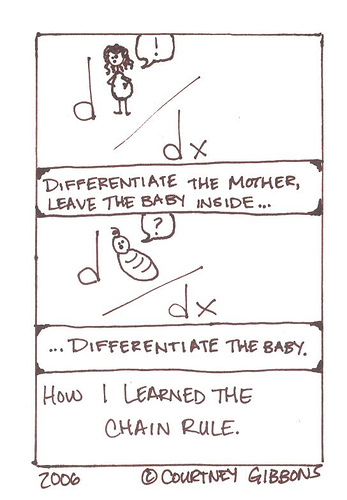
    I love this comic by Courtney Gibbons on "How I learned the Chain Rule."  I showed it to my classes this year:


    I never really liked using the terms "inside" and "outside" functions anyway.  Maybe because you can decompose functions in an infinite number of ways, and those terms, to me, imply that there is only one inside and one outside function possible.  I don't know.  Maybe I'm being too picky.  But, I kind of liked the mother/baby analogy.  And my kids LOVED it.  It's hilarious when someone walks in and my kids are muttering, "Ok, now differentiate the baby..."

    But, in all honesty, here's what I really like about this comic...you can extend the idea, which is something you cannot do with the terms "inside" and "outside" functions.  Here's what I mean, let's say you have a function such as y=f(g(h(x))).  Now you have baby (h(x)), mom, (g(x)), and--you guessed it--grandma (f(x)).  The kids went wild the first time they heard this.  But, seriously, it works.

    *****

    I'm pretty sure I haven't posted this before, but here's a worksheet for practicing the chain rule.  My textbook doesn't have a lot of these types of problems (actually, I don't think it has any), but AP Calc students (well, I think all calc students...) need to learn to recognize that the chain rule is required to differentiate functions in the form of y=f(g(x)), even when f and and g are not explicitly defined.

    It looks like there's four pages  here, but it's really just two (I print two pages to a sheet so that they'll fit in students' composition notebooks).  The second page  gives practice with functions defined by a table.

    Here ya go!


    *****
    One more note on chain rule.  When we have a trig function raised to a power, such as y=sin^2(x), I encourage (read make) my students rewrite the function as y=[sin(x)]^2.  This makes it much easier for them to identify the mom (x^2) and the baby (sin(x)).  I try to start this habit in PreCalc so that it's second nature by the time they see it again in Calculus.

    And that's that.  Chain rule...I'm getting a little better at it.  Slowly but surely.

    Another Review...

    I'm always trying to fine-tune review activities.  I used to be really into review games.  I would spend hours creating games that we'd play the day before a test.  They're fine:  I still use several of them.  But my criteria of what constitutes a good review has really simplified to two things:

    1. Students do most of the work/explaining (not the teacher)
    2. Students can self-correct their errors
    These two objectives led me to a very simple review for my PreCalculus classes that I thought went swimmingly.

    The kids were given a study guide to review for their Quarter Exam (kind of like the Quarter Quell...just kidding...sort of...).  The next day, they were to come to class with a note card with a question like one from their study guide but with different numbers and multiple choice. I didn't tell them which problem to work; I asked them to pick one that they felt they needed more practice on.  (Because if one student needs more work on an objective, then there will be other students who need help in that area also.) Additionally, they were asked to fill out this Google Form so that I could have a key to their questions without having to work fifty problems:


    I took two days to let the kids work through all the problems (the first day they worked through their class's cards and the second day they worked through the other PreCalc class's cards).  I made slips of paper with the numbers 1-49 (each kid was assigned a number) so that they could keep a record of their answers (and I could grade them easily).  I made them go back and correct the ones they missed.

    This was absolutely lovely because I really didn't have to do anything these two days.  Normally I walk around and take questions, but I wanted the kids to be answering their own questions.  If someone would try to ask me a question, I would tell them to ask the person who wrote the question.

    This is the rubric I used:

    Q2 MC Test Question Assignment (10 points)
    2 points: Create a question like one from the study guide with at least medium difficulty

    4 points:  Four good multiple-choice options:  one correct answer and three good distracters

    1 point
    : Index card formatted correctly:  assigned number on the top left, question with all four answers, name and hour on back

    1 point:  Very clean handwriting

    2 points:  Correct answer submitted on Google form (tinyurl.com/Q2multiplechoice) by tomorrow’s class


    Things I really liked about this:
    • I didn't have to write any more problems.
    • Students got practice writing good multiple choice problems.
    • Students were the ones doing the work; not the teacher.
    • Students got lots of practice with the types of questions that they tend to struggle with.
    The only thing I didn't like so much:
    • Some kids didn't have a correct answer on their card...but kids usually found the mistake on their own.
    I really liked how this played out.  Super easy on the teacher's part, and kids got loads of practice.


    Thursday, June 26, 2014

    Slope Field Activity

    I’m getting ready for Twitter Math Camp's calculus working group (ah!).  We’ve been asked to bring some activities to share with the group, so I’ve been frantically searching my blog this afternoon for stuff I can contribute.  I was typing up a list when I realized I don’t have a whole lot for the second semester of Calc AB.  I imagine a lot of that has to do with the fact that we’re in review mode for half the semester, but still.

    However, I did realize that there was one pretty good lesson on slope fields that I didn’t blog about.  I probably didn’t write about it because I stole it 100% from my APSI instructor last summer.  Nevertheless, I’m not feeling that trepidation currently.  This magic should be shared.

    • On the board, draw or project a blank Cartesian plane along with a differential equation.  There should be at least as many integer coordinates as there are students:


    • Give each student a card with a coordinate on it.  {If you're as Type-A as I am, here are cards you can print for up to 35 students.  And if you're REALLY Type-A, you can print them on card stock, laminate them, and cut on the solid lines.  I love laminated cards.  Laminated cards make me feel like I just insured a valuable asset. Moving right along...}
    • Each kid figures out the slope of the tangent line at the given point and draws a tiny line segment with that slope at the given point.
    • When everyone is finished, they’ve all contributed to a graph that looks something like this:

    My class's actual slope field;
    not perfect, but whose slope field is?

    For this example, we discussed questions like:
    • What's the pattern for the slope to be zero? Why?
    • What is the slope doing to the left of y=x?  Why?
    • What about to the right? Why?
    And I mean that was pretty much all they needed in the way of instruction.  Not that it's all that complicated to begin with, but this was a nice, everyone-get-up-and-contribute type of lesson.

    Again, I can take zero credit for this.  But I thought it was worth sharing.