Showing posts with label lesson. Show all posts

Wednesday, April 17, 2013

Noticing and Wondering with the Binomial Theorem

This is my first year teaching Pre-Calc.  However, with the exception of our trig unit (which, granted, is a good portion of the class), I've taught most topics we cover in Pre-Calc.  But, today's lesson was on the Binomial Theorem, which I had never taught before.  As I was reading up on it, I found myself noticing and wondering.  There's so much to explore.  At first glance, do a bunch of expansions look all that thrilling?  Maybe not.  But, the more you dig into it, the more patterns you begin to find.  So, I decided to put my students to the challenge, too.  This was their warm up today:


I gave them 3-5 minutes.  And then I started calling on people to share, writing their thoughts on the board so everyone could see.  They were hesitant at first but grew more confident as we went on.  After I had called on several kids, I asked if anyone else had something s/he wanted to contribute.  These are the lists we made in my two classes:


Mostly, I just wanted to share my students' thoughts, because I thought they did a great job for this first-ever notice/wonder assignment.  Also...the second class's "wonder" was, of course, the very nature of the lesson, so...mwah!

Sunday, April 7, 2013

My Unit on Rational Functions (Algebra II)

Disclaimer--this unit is fast and very calculator-heavy.  It would need a good deal of reconstruction for an Advanced Algebra II course.  Nevertheless...

Part I:
Review of asymptotes via Asymptote Bingo

Part II:
Introduction to rational functions via this foldable:


*I think you could use this in an Interactive Notebook if you just deleted Example 3.

Part III:
Exploring rational functions via Desmos

This was my favorite.  Oh, Desmos, how I love thee.  I wrote this literacy/technology activity for my students and then we headed to the Math Lab together to work on the computers:


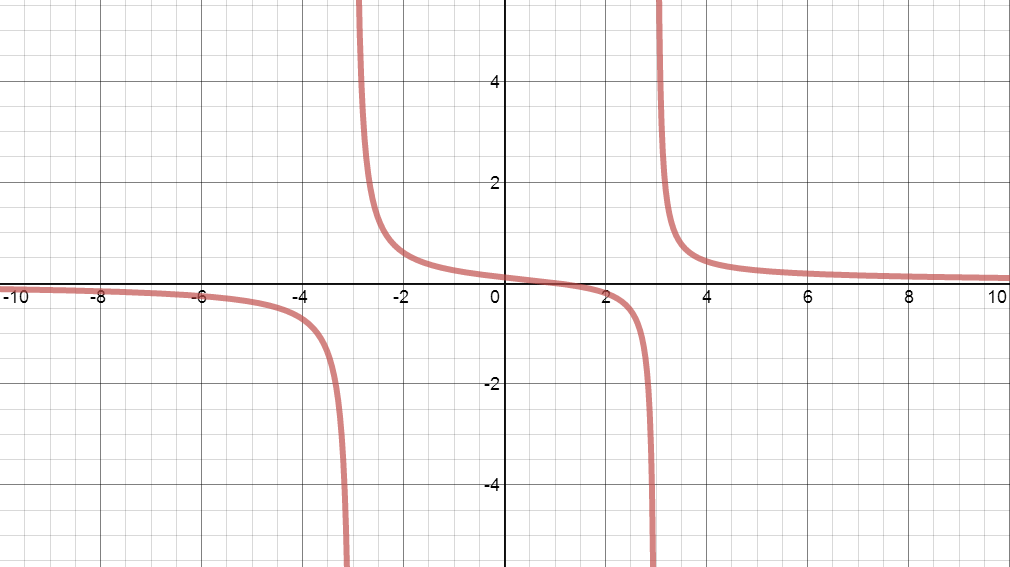
We have really nice, big screens in the Math Lab so the kids were able to get beautiful and clear pictures of these functions, which (I think) a typical handheld graphing calculator can't quite provide.  Here's what I loved:  The kids would graph the function in question, for example this:


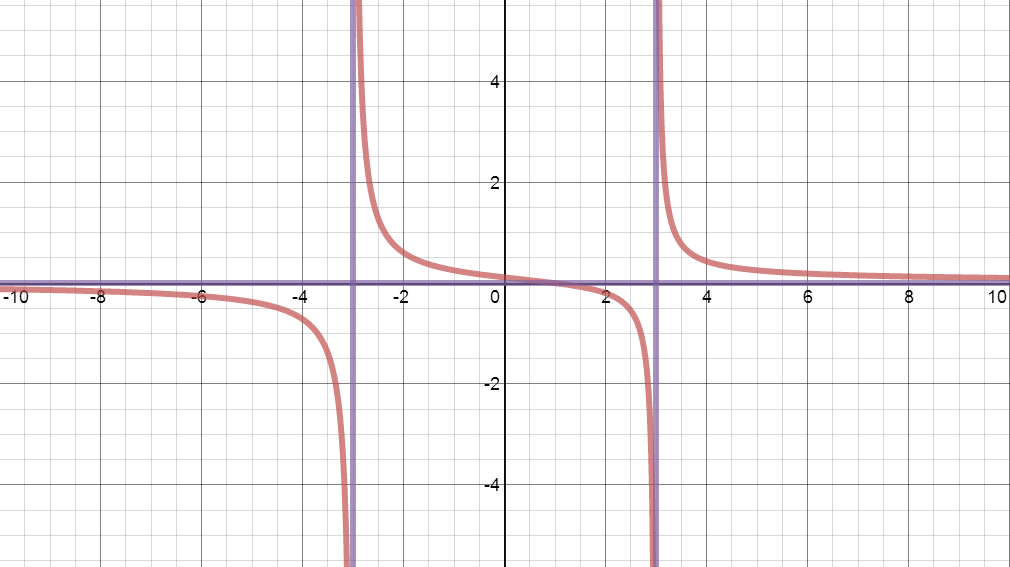
And then they were asked to analyze.  I asked them to graph all their asymptotes and highlight all intercepts.  So, if they accidentally said that the horizontal asymptote was x=0, when they graphed their answer, they (usually) immediately identified their mistake and made the appropriate corrections.  (Or, at the very least, they raised their hands and told me, "This doesn't look right to me...")  If done correctly, their ending picture should have looked something like:


So beautiful and clean!

Part IV:
Solving rational equations through graphing and technology

Including review and assessment, I spent just over a week on this unit (like I said, it was fast).  But I'm pretty happy with it--especially our day in the Math Lab.  I worked out some issues with the activity, so I'm interested to use it again (I want to try it in PreCalculus) and see how it goes the second time around.

Thursday, March 21, 2013

Introduction to Tangent Lines

I've been loving this introduction to calculus that we're doing with our Pre-Calc classes currently.  I don't know about you, but when I was in Pre-Calc, I didn't do any calculus.  Not a single thing.  I had no clue what a limit was, and certainly not a derivative. My Pre-Calc class was pretty much just trig, trig, and more trig, with a bit of "advanced" algebra thrown into the mix.  (I'm not complaining though--it was a great class, honestly...and I'm told I should be thankful that I'm young enough to even have had a class termed "Pre-Calculus.")

Anyway.  All this to say--it's darn exciting introducing kids to concepts such as limits, derivatives, and integrals because they're so powerful and beautiful...and so unlike other stuff we teach (no?).

So, a few things I'd like to share from this week.  Nothing's super original, but I did put a lot of time and energy into making them work for my students.

First:  Visualizing secant lines turning into the tangent line via Desmos.  Again, I know there are plenty of applets out there, but I couldn't find any that my students in the back of the room would be able to see.  Also, I wanted to input my own functions.  Also, I wanted to create it because it's fun and allows me to use mathematics.  So, here you go.  Slide a, change the function, change the point of interest.  Best of all, put it in projector mode so everyone can see--even the kids in the back.

Second:  We had an extra day built-in for tangent lines, so during collaboration, I asked if we could create a packet that introduces the kids to how to draw those lines exactly.  And how does the algebra relate to the geometry?  My department head and I discussed the objectives, and then she miraculously turned our words into this beauty:


Third:  This Warm Up that I rather like (Day 3 of Tangents):


Fourth:  I used these sites so the kids could get some practice visualizing what the derivative function would look like without taking the time to actually find it algebraically.  I love exercises like this because they truly require deeper thinking.  You can't bs your way through them.

Tuesday, March 12, 2013

Solving Exponential and Log Equations Flow Chart

I guess I've been kinda into flow charts this year; I created another one for solving exponential and log equations.  The idea is that kids start with the top box, if they can't complete that task, then they go on to the next box.  We put examples in each box.  I used this for both Algebra II and Pre-Calc this year.

It's not flawless, because mathematics requires more creativity than a flow chart can provide.  But it gets the basic ideas across.


Friday, March 1, 2013

Newton's Law of Cooling :: A Murder Mystery

You know those lessons/projects you give your students that you look back on and you're like, "Wow.  That wasn't half bad"?  I had one of those recently in Pre-Calculus.

We've all seen those exercises in textbooks where students are supposed to figure out the time of a person's death using Newton's Law of Cooling and given certain temperatures and times.  I always liked those problems, but never really knew what to do with them, more than just present them and say, "See!  Math IS applicable to real life."

Then a colleague of mine showed me a literacy activity adapted from Key Curriculum Press.  I found a version online that I used (but it was a direct link to the Word document, so I don't know to whom to give credit!).  The first page is what I found online (I added Newton's Law of Cooling to the bottom); the second page is the instructions for the kiddos, which includes the rubric:


To start out, we first had to watch a trailer for BCC's Sherlock (LOVE):


I gave the students about a half a day to figure out the math and solve the murder.  The next day, I loaned out a laptop cart from the school and the kids finished the story, working in groups of 2-3.  I had the students submit their posts on a blog I created for our class via kidblog.org.  My principal told me about kidblog, a class-friendly version of Wordpress, and I absolutely love everything about it (except its name).  Students don't have to register or sign in with an email account:  you just set up usernames and passswords (which can be done in a jiffy) and then they can log in.

On the blog, I posted a sample writing that I found here.  (The math is a little off, so be sure to fix it if you use this link--the final t should be negative.)  This really eliminated the "I don't get what you want us to do!" comments because the students had an example with which to model their writing.  In fact, I didn't get a single such comment (kuddos, kids).  However, I also protected this sample with an extra password:  students could not get into the post until they had solved the crime, as the password to the post was the time of death (see, kidblog is awesome).

Once all the posts were in, I gave the students a couple days to go back in and comment on their favorite posts.  The posts with the most comments received some bonus points.

I was honestly blown away by my students' response to this assignment.  Their stories were original, entertaining, and included the required mathematics.

There's obviously room for growth here on my part, but for the first go-around, I was incredibly pleased with this activity.  Next time, I may make the crime a bit harder to solve, and I may give different versions.  We'll see how motivated I am.

Out of respect to my students, I don't want to post the password to the blog here.  But, if you'd like to check out their stories or the blog for instructional purposes, feel free to tweet me (@RebeckaMozdeh) or email me (rebecka dot peterson at gmail dot com).

Saturday, February 16, 2013

Fail Friday...on Saturday

I had been meaning to get help on this activity a while back, so Fail Friday seems to be the perfect opportunity for this.

Anyway...somehow I managed to totally suck at explaining intercepts this year in Algebra II.  Even after an entire semester with these kids, when I say, "What's the y-coordinate of an x-intercept?" all I get is *chirp, chirp, chirp.*

I wrote up this literacy strategy, that I was quite proud of.  I felt like they finally understood the algebraic definition of an x-intercept, and not just the geometric definition (i.e., I want more out of them than just "An x-intercept is where the graph crosses the x-axis.").  But...the next week I felt like we were back to square one.

Help!  How can I help them understand and generalize the concept of an intercept?  I especially want them to understand how factors and zeros are related.  What have you tried that you have had success with?  Class composition is juniors and seniors.

Sunday, February 10, 2013

Using clickers in the math classroom


Last semester my school purchased a few sets of classroom clickers.  I wrote a proposal for a classroom set with colleague, and we now share a spanking new set of Turning Technologies clickers.

I'm going to be honest--I really don't have much experience with other clickers (not even SMART clickers), but I will say this--I have been incredibly pleased with these clickers.  The initial setup is just a matter of copying your rosters into the software; you then assign a clicker to number to each student; and voila, you're ready to go.  My students are now in the habit of just picking up their clicker as they come in to class, just like they pick up a calculator.  There is no on/off button on these clickers, and students don't have to log-in, so I lose essentially zero instructional time.

Also...these clickers aren't just programmed for multiple choice responses.  You can have students enter short answer and numeric responses, too.  Love.  This.

So, that's my plug for Turning Technologies.  Now, a few things I've used these marvelous clickers for:

Are you with me?
Since there's no set-up/login time, I can say, "Ok guys, click A if you're with me, B if you're not," and the responses instantaneously come up on my computer.  For a question like this, I don't show the percentage of students answering A or B, but it's a great way for them to anonymously tell me, "Hey, I'm not quite following you yet...could we do one more example?"  Or, conversely, "We're bored to death, Mrs. Peterson, please pick up the pace."

Warm Ups
This is was my original intent for the clickers, and I love it.  I usually start with a warm up or review question, and I have students poll in their responses.  Students are engaged because they want to see if they got the question right, and if they did get it right, how many others did, too.  For these questions, I usually display the bar graph that shows the distribution of responses.  I can say, "Look!  80% of you said the conic was a hyperbola, and you're right!  So-and-so can you tell us how you came to that conclusion?"

Daily Practice--Differentiating Instruction
After instructional time, I can give the kids a set of problems to work on.  For example, last week I gave them eight questions on condensing and simplifying logarithms.  Once they polled in their answers, I gave them an assignment from the book (ah!), but they only had to work a certain number of problems based on how many they originally answered correctly.  Since the clickers are numbered 1-35, I could tell the students how many they missed, without revealing to the others who missed what.  I just said, "These are the clickers that didn't miss any, and, hence, only have to work six problems from the book:.... " (And, boy, you could hear a pin drop in the classroom as everyone was waiting to hear his/her clicker number called.)  "These are the clickers that only missed 1; you only have to work 8 problems," etc.  Once the kids started to finish up the assignment, I asked them to go help their peers.  They seemed more willing to do this than ever before.  Perhaps because they have the confidence of "I didn't miss any!  I can explain this stuff."?

Assessment Time--My Favorite
There are two types of polling for my clickers--"Anywhere Polling" and "Self-Paced Polling."  Anywhere polling is what I use for warm ups, when I mostly just want to see how my class is doing as a whole.  Self-paced polling, on the other hand, allows you to pre-enter keys so that you can get a feel for how each student is doing individually.  This is the mode I use for daily practice and assessments (i.e., when I want to take a grade).  One of the great things about this mode is that you can make multiple versions.  I typically don't bother with this when we're just doing daily practice, but when the kids are testing, you can bet I have more than one version out there.  The clickers just ask which version of the test you're taking, and then you're good to go.  For my sweet kids, I walk around the room after they've started testing and I personally enter which version they have into each of their clickers (I don't even put it on the test anywhere, I just mark the versions in sneaky ways that only I am privy to).  So, the multiple-version thing is pretty awesome.

Another great thing about this is that I can allow students to correct their mistakes.  For example, I've allowed them to poll in their answers, and then come to my desk before submitting the test.  I then marked the questions they got wrong and they were able to change their answers in the clickers.  They corrected their own errors.

Of course, the best part of all of this is that I can spend much less time on grading and more time planning successful lessons.

If you have other ideas for clickers, I'd love to hear them in the comments, or you can contact me in the tab on the top there.  The more uses I can find for these, the better!

Saturday, January 19, 2013

Conic Sections Flow Chart

I just finished conic sections with my Algebra II kids.  I used the Conic Cards, created by the wonderful Cindy Johnson (@Johnsonmath), with whom I get to teach in the same building!  Both Kristen Fouss and Amy Gruen have used the Conic Cards and written about the awesomeness of them here and here.  They are truly amazing.  I was dreading teaching conic sections, but after two weeks of card matching (and the two weeks were right after Christmas break, I might add), the kids were able to knock the socks off their first test of the semester.  Which leaves us all happy.

In order to emphasize the similarities and differences of the equations for conic sections, I created this flow chart that the students filled out and used once they had learned all four conics.  Before the flow chart, every time a kid would say, "Mrs. Peterson, is this a hyperbola?!" I would go through the same questions with her:

"Are both variables squared?"

"No."

"Good.  So you know it's not a...?"

"Parabola."

"Awesome.  Now are the squared terms being SUBTRACTED?"

"Yes.  Oh!  Yeah, it IS a hyperbola."

I got tired of going through these questions over and over and over.  Also, I don't think the kids realized the order in which I was asking the questions, which didn't do much for them except answer the immediate question.

So, now, instead of answering their question with a string of my own questions, all I have to say is, "Do you have your flow chart out?"  Much less work for me.  A little more work for them.  And they're reading.


The wording isn't perfect.  I don't know how to succinctly differentiate between the ellipse and the circle in standard form.  This is the best I came up with.  Of course, then kids think as soon as an equation has fractions in it, it can't be a circle.  That's not really what the wording says, but I totally understand the confusion.  I combated the confusion the lazy way:  all our circles' centers were (m,n) when m and n were both integers.

Another good thing:  this flow chart can be easily changed to classifying conic sections in general form.  I just had the students take a few extra notes on the side (such as changing different denominators to different coefficients), and they were good to go.

All in all, conic sections went very smoothly.  And now onto exponential and logarithmic functions!

Saturday, November 3, 2012

Warm Up for i

Sometimes we have to relish in the little things, right?

This is a warm up I gave to my Algebra II students, just a couple days after they had first been introduced to i:


While I do like the warm up, what I'm really quite proud of is how I implemented/graded it.  When students felt like they had finished the warm up, I had them let me know.  I checked their work quickly.  If I liked what I saw, they were given the day's assignment (and a 100% for the warm up).  If not, they were given some verbal questions from myself, such as...

"You say i is imaginary, but you also say it's equal to -1?  Are you saying it's impossible (not real) to lose a dollar (-1)?"

"i is equal to the square root of 1?  But the square root of 1 is...?  Oh, so we need two symbols for the multiplicative identity now?"

"i is equal to i?  Try again.  This time tell me something."

Yes, I was harsh and sarcastic.  But this is an important concept.

Eventually, everyone had true sentences on his/her paper (which means everyone who came to class got a 100).

Each day I've been doing an "EOI Preview" as a warm up and I've been taking the highest 3-4 grades for the week.  This warm up gave everyone a chance to get an excellent grade in for the week, and I didn't let students move on until they could articulate the truth.

I know, I know...I really need to switch to Standards-Based Grading.  Sigh...

Thursday, November 1, 2012

They're going to be prepared for calc...so help me God

I've written before about how I feel like a concept we think our students get that they really don't get is the composition of certain functions, specifically trig functions and log functions.  I made a vow to myself to emphasize compositions with my Pre-Calc students a lot this year, so that when they do get to calculus, the Chain Rule and u-substitutions will be two of their best friends, as opposed to worst enemies.

I was reminded of this vow when I asked a student to read an exercise from the book out loud.  The exercise started like this:


And this is how she read it:

"Sin" [as in a transgression, not a trigonometric function] "times pi over two minus x."

I wanted to say, "When have you EVER heard anyone say it like that, girl?"  But, I remained calm.  I ignored the mispronunciation (we have bigger fish to fry here), and focused on the "times" part.

It seems like every time I have this conversation ("It's not 'f times x,' it's 'f of x,' guys."), I feel like the kids are just nodding to get me to shut up.  I can't blame them.  I did the same thing in grad school [way] more than once.  As long as I make the prof think I understand what he's saying, all will be well.

But, inputs.  They're kinda a big deal.  What worries me is that it seems like students often view inputs as some kind of multiplication as opposed to actual arguments, which makes sense as the notation is very similar (parenthesis for both).

I continued to notice this was a problem as we were verifying trig identities.  I don't know if the kids just got so into the proofs that they forgot a few fundamental things...like what sine and cosine are...or what was going through their heads exactly.  But, let me tell you, I saw crap like following slide all. the. time.  So, I made them figure it out:


I would not tell them what was wrong, but I did mention it was subtle.  When they finally started figuring it out, we talked about why we need all those theta's!  Our dear trig functions are meaningless without them!

It's a small step, but if it gets them to remember that these trig functions must have an angle at which they're to be evaluated, even if that angle is arbitrary, well, then, that's a good thing.

Sunday, October 14, 2012

Teepees for Factoring

One thing that's been very shocking to me as I've made the transition from college instructor to high school teacher is the lack of number sense that many of my [Algebra II] students possess. Estimation skills, knowledge of times tables 0-12, and the recognition of a negative sign are so sorely lacking.  On a daily basis, I get told that a negative plus a negative is a positive, because, "two negatives make a positive, Mrs. Peterson."  Students also regularly explain to me that when we multiply a negative times a positive, the product will take the sign of the larger factor.

I haven't figured out how to break these bad habits.  But I'm working on it.

Needless to say, the thought of teaching factoring was a bit daunting.  How can I teach them to un-distribute, if they can't distribute correctly in the first place?

And then a couple colleagues of mine introduced me to the x-method, or what I call the teepee method.  This may be old news to many, but I had never seen it before, and I found that it was just the bit of organization some of my students needed in order to factor trinomials.

So, let's say we want to factor x^2-9x+20.  We create the following teepee:

Then we find two numbers that multiply to be the top number and add to be the bottom number:
And, viola!  Then we can factor the original trinomial: (x-4)(x-5).

This by no means solves all my problems.  How can we find those numbers in the first place if we don't know how to multiply?  However, it is a nice little organizer for those students who are visual learners.

I can't take any of the credit for this visual organizer.  I'm just passing along what I learned from my wonderful department.  But, in the words of LeVar Burton, "Don't take my word for it."  Here's what some of my students wrote when I asked them to choose their favorite form of factoring from the ones we had discussed so far (GCF, difference of squares, and trinomial factorization) and tell me why...


“Trinomials are my favorite because I like to make lil x’s and then put the numbers inside that would make the others true.”

“My favorite factoring exercise is trinomial factoring because it really makes you think.  The x’s really help too.”

“The trinomial factoring is my favorite because it’s easy to use the teepee.”

Sunday, October 7, 2012

Function Transformations/Domain and Range: Day 2 (and a bit more)

Day 2:  Domain and Range of Parent Functions

I started the year with domain and range of a finite set of points, because, it's an easy concept and I wanted my students to know--Algebra II is totally conquerable.

Fast forward a month, and I think they might just ready to handle a continuous case.  We broke it up sloooooowly and built towards finding the domain and range of the four functions they found the day before.

Domain and Range

Obstacle #1:  Closed circle v. Open Circle
I really enjoyed this part of the lesson because the students were totally in to the closed circle v. open circle, which is awesome...but not before we jumped over a few hurdles.  When I asked them what an open circle denotes in mathematics, a few people proudly reported, "Parenthesis!"

No, sweethearts, an open circle does not mean parenthesis, last time I checked the dictionary.

So, we got to talk about my favorite branch of all--analysis.[1]  How could we write all the numbers between -5 and 4, but not including -5 (see fourth slide above)?  Of course, [-4.9, 4] was suggested.  But then poor -4.99 (just to mention one) gets left out!  Any number they suggested that was close to -5, but bigger, I could always find a number that was even closer (thanks, density!).

Hmmm...

And then a kid suggested something that was absolutely brilliant.

Incorrect, but brilliant nonetheless.

"Could we use -4.999...?"

Cue look of How far do I dare take this subject with these kids?

I wasn't quite sure.  And still am not so sure.  I decided to write this on the board:

-4.999... = -5

"This is what we know, and can prove, mathematically:  that -4.9 repeating is equal to -5.  So, sadly, writing [-4.999..., 4] does not help our quest because that's the same as [-5, 4], which is what we were trying to avoid in the first place."  BRILLIANT thought though, loquacious kid in the front row.

So, new notation is all that we could come up with in order to fix this dilemma.  Parenthesis.  As was wildly suggested before.

Now if only they could remember a few of the deeper ideas as opposed to just "open circle=parenthesis."

Obstacle #2:  Domain of Deceiving Functions
Here's what I mean by a deceiving function.  I took y=x^3 and showed a graph like this:

Graph Plot

Most students were convinced that the graph would never pass x=-3 on the left, and x=3 on the right; hence the domain must be something like [-3,3].  And who can blame them?  They haven't developed a good sense for what the graph of a function is yet.

But that's ok.  Because we have Desmos.

So, to abettercalculator.com we went to graph the function, along with the line x=-3:


The kids' case was looking good.  Until we started scrolling down:


And down...

Aw, isn't that a lovely linearization...

And changing the y-axis view even more...
Gah!

And this convinced many (though not all)...the domain is indeed all real numbers.

Days 3-5 were spent focusing on vertical and horizontal translations.  We tried vertical stretching/shrinking, too, but I started to lose several of them, so I decided parent functions, domain/range, and translations were plenty for now.  We can come back for the rest later.  That's the beauty of 180 days, as opposed to the 48 that I'm used to.

Before the unit test, we played Kate Nowak's Speed Dating Game, but I adjusted it for these topics.  You can find the game cards I created here.

[1]  I claim analysis/advanced calculus as my emphasis in grad school...mostly because that's what I took the most classes in and that's what I took my written comprehensive exams in.  In any case, while I can't say I've read that many texts on analysis, I can say, that Understanding Analysis by Stephen Abbott is, by far, the best text I've ever seen on introductory analysis.  All calculus teachers should be required to read it.  Truly!  It's the best.  Get the whole thing for free here.  Go.  Read.  ENJOY.  He's a master teacher.

Tuesday, September 25, 2012

Function Transformations/Domain and Range: Day 1

As I've said before, I'm all for the motto of "The person doing the work is the person doing the learning," and I fully believe in making the students do the work in class.  However, I do think something gets overlooked a lot with this motto:  if I want my kids to be doing the work in class, I usually have to prepare a crapload outside class.  I'm willing to do this (most days).  But, I don't think that gets stated enough.

Being new to this age group (and never having attended a public high school myself), the trick for me is to anticipate the students' every move:  to come up with activities and lessons that are challenging enough to keep 36 students at 36 different levels engaged for an hour, but that are not too difficult so students just give up (or call your name so many times that by the end you're dizzier than a Turkish whirling dervish).

Some days these lessons flow out a lot faster than other days.

This was not a lesson that came quickly.  My insomnia from grad school is back and running, so this is a lesson that got started around 5 in the morning on a Saturday (I repeat, 5 in the morning, on a Saturday), and got finished sometime in the late morning.  For all that work, it has a lot of flaws.  But it has some good aspects, too.

So, here's Day 1 of Parent Functions, Domain/Range, and Transformations

Day 1:  Introduce Parent Functions

I really believe one of the most important skills I can teach my students is to read, comprehend, and subsequently follow directions.  There are so many cool things I've learned in my life, and so many more cool things I hope to learn.  But I couldn't have learned most of those cool things if I hadn't taken the time to read, comprehend, and apply my knowledge.  With that in mind, we had a big-time literacy day in Algebra II.

Students were given these xy tables, graph paper, and the directions below.  Not a whole lot else.  At first, they were livid.

"I don't get it!"

"Read the directions."

"What do you want us to do?!"

"Read the directions."

"You haven't taught us this!"

"Read the directions."

"UGH!"

"Read the directions."

It was an exhausting day, I'm not going to lie.  But they eventually caught on, and I learned that some of them are great at reading, comprehending, and applying, and some are not.  Here are the directions.  Many thanks to @Fouss for the subtitle. ;)

Parent Function Directions

Not everyone got to Part II, which was actually nice as it allowed for differentiated instruction.  I posted the best graphs from Part II in the front of the classroom so that students have these four parent graphs in front of them at all times for now.

What I liked

  • Students READ.
  • Students did the work.
  • Students focused on a small amount of information:  four rather important graphs.
What I didn't like/Questions I still have
  • Do they really understand that the graph of an equation is the representation of every single solution of that equation?  I feel like I say that a lot, but that doesn't mean anyone actually understands what I'm saying.
  • It's not super exciting.  I know these graphs have a lot more interesting aspects to them then just "Draw an xy-chart and plot the points," and I feel like maybe I stripped them of a lot of their intrigue.
  • I let the students pick their own groups.  I still don't know if that was good or not.  The complainers tend to be friends with each other.
  • I only printed one set of directions for each group because I'm more than a little frugal with my copies.  Also, I wanted them to work together.  However, I think the students would have benefited from everyone having his/her own set of directions.
I will post more on the unit soon!  Hopefully!

Sunday, September 23, 2012

Systems of Linear Equations Activity: 3 Cases

So, this isn't anything super fancy, but it worked quite well with my Algebra II kiddos (without much prep on my part, which doesn't happen often), so I wanted to archive the idea and hopefully get some feedback/ways to improve it.

I gave four lines in slope-intercept form and had my students get out a clean sheet of paper, fold it twice to create four quadrants, and write one of the lines at the top of each quadrant.


Then they were to write four categories (in each and every quadrant--oh my!):
  • Given line (Y1)
  • No solution line (Y2)
  • Infinitely many solutions line (Y3)
  • One solution line (Y4)
The given line (Y1) is the line I gave them.

For Y2:  we talked about what would need to be true about the second line in order for it to never touch the given line.  The kids were pretty quick to tell me that the lines would have to be parallel, and for that to be the case, the lines would need to have the same slope (and different y-intercepts, btw, cherubs).  A-ha!  We do remember some things from Algebra I!  So, we decided on a line that was parallel to Y1 and wrote it in the category of "No solution line."

For Y3:  we discussed what would need to be true about a line in order for it touch the given line at each and every point on that line.  Well...it's gotta be the same line!  Write that in the category of "Infinitely many solutions line."

For Y4:  the typical case, but I love that this activity made them think a little deeper about this case.  "So...what has to be true for a line to touch the given line once and ONLY once?"  Pause.  Pause.  Pause.  

Still, small voice:  "Different slopes?"

Oooo...

"So, a line with ANY slope other than that of the given line will intersect with the given line somewhere?"

Pause.  Pause.  Pause.

Unanimously:  "YEAH!"

Wohoo!  So, we made up a line with different slope and wrote it in the category of "One solution line."[1]

Graphing calculator time...

For the given line of y=2x+1, our y= screen may have looked something like this:


We changed the features for Y1 and Y3 so we could distinguish between the lines and actually see the calculator graph the given line again for the special case of infinitely many solutions.  I had them sketch these lines at the bottom in addition to stating the point of intersection for Y1 and Y4 (they could use their calculator).

I did one of these exercises with them and then had them do the same thing for the remaining three given lines on their own/with their partner.

About half-way through the period, I had them turn their papers over.  Using the same quadrants and the same lines they created, we solved each of the three cases algebraically.  That's twelve systems they solved in half a lesson.  The goal was to get them to see that algebraically a false statement is related graphically to two lines that never intersect (no solution); that a true statement is related to two lines that always intersect (infinitely many solutions); and that a conditional statement is related to two lines that intersect once (one solution).

Again, it didn't take lots of prep and I think it really brought together the geometry with the algebra.  I hope you're proud, Descartes.

[1]  Lots of students would just change the slope of the given line but keep the y-intercept.  Then, when they solved the system, they noticed that x always turned out to be zero.  "Mrs. Peterson!  I keep getting x=0!  What's going on?"  "What did you keep the same?"  "The y-inter...oooo..."  Light bulb.  One kid was so excited about this I truly thought he was going to pee his pants.  It's the little things in life.

Monday, September 10, 2012

Week 4 :: Writing Piece-wise Functions

A prompt for the final week of the New Blogger Initiation was to write about another new blogger's post.

Maggie (@pitoinfinity8) posted an awesome activity for piece-wise functions in which students literally cut up the different pieces of a given function and then puzzle them together.  Brilliant.  In response, Bowman Dickson mentioned that it might be useful to go the other way, too; in other words, give the students the graph and have them write the equation.

I love both these ideas:  the first gets the students to read; the latter gets them to write.  I didn't read Maggie's post until after I introduced piece-wise functions this year in Pre-Calc, but I did read it in time for our first test review.

So, here's what we did...


I gave them a few minutes to answer these questions and then we used their answers along with the restrictions to write the function.

Onto another one:

They were rockin and rollin, so I asked them...


This time, I gave them the problem in the traditional manner:


Success!  Finally!  Many thanks to Maggie and Bowman.  What a great way to review both piece-wise functions and function transformations.

Speaking of function transformations, a twitter conversation in which I laughed out loud:


Monday, August 27, 2012

Week 2 :: A Warm Up I'm proud of

One of Week 2's prompts for the New Blogger Initiation is to pick something--anything--that we've created that we're proud of.  If I read it correctly, it can even be just a problem.

So, here goes: a Warm Up/Bell Ringer/Do Now that I'm quite proud of.  It's the pre-cursor to a lesson on transformations for Pre-Calculus:

WARM UP (Do Now)

  1. Write f(1)=2 as an ordered pair.
  2. If you know the point (1,2) is on the graph of y=f(x), what point do you know has to be on the graph of y=f(x)+3?  Why?  (Hint: What is f(1) equal to?)
  3. What about on the graph of y=f(x+3)?
Plotting these transformations gets us thinking about translations and (I think) reveals the "opposite" behavior of the "inside" transformations.  (Though it's really not opposite at all, is it?!  Yay for math!)

That's all I have for this week!  Thanks to the wonderful people at the blogging initiative for encouraging continued writing.

Friday, August 17, 2012

New Blogger Initiative :: Week 1

I just started blogging a few months ago, and I can say it has been an amazing source of professional development for me.  I've gotten to connect with incredible math teachers that I really look up to, and I'm hoping to connect with more of you through the New Blogger Initiative.

Those of us who signed up for this shindig received six topics we could choose from this week.  One was:
Where does the name of your blog originate? Why did you choose that?
I was tempted to to respond to this prompt and just get rid of this page.  No one would be the wiser.  But, I figured that would would kind of defeat the point of this initiative, so if you're interested in why I named my blog Epsilon-Delta, feel free to peruse the aforementioned page.  Instead, I chose this question:
Talk about one or two specific things you plan on doing differently this year... and how specifically you are going to implement them/get the buy-in. Why do you want to do these things?

Two things I want to do differently this year:
  1. Introduce more math history
  2. Make students do more work in class
So, maybe a bit of background is necessary first here.  I've spent the past three years teaching at the college level.  Last year I taught concurrent College Algebra classes at a high school (so I was employed by a college but taught at a high school).  I liked the high school so much that I'm switching over to teach for them this year.  And that's about it. :)

1.  Introduce more math history.  This is something I've been pretty lame at the past three years.  Basically, the extent to which I teach math history can be summed up as "Hey, go research this mathematician and I'll give you some extra points on the upcoming test."  One of the things that I'm really excited for in switching to high school education is that I'll get about quadruple the amount of time with my students.  With that kind of time, there's no excuse for me not to do a better job with the whole math history thing.  One of the reasons I really want to incorporate more math history is that I know I learn better when there's context to what I'm studying.  I'm hoping that this is true for my students as well.  The second reason I want to incorporate it more is that it's freaking fascinating.  Mathematicians lead crazy lives.  And they're just really interesting.

So, how do I plan to do this?  Well, this year I intend to have a new mathematician up on one of my whiteboards every month.  Students will receive homework bonus points for writing at least a paragraph on the math superstar.  In addition, if they share one fact with the class and write it on the board, they'll receive a point for their class.  The class with the highest number of points at the end of each quarter will get some kind of prize.

2.  Make students do more work in class.  When I interviewed for my position I said something like, "I believe the person doing the talking, the person doing the writing, the person doing the work, is ultimately the person doing the learning."  The principal and the math curriculum specialist shot each other very strange looks at this point in the interview.  "Did you feed her that line?" they asked each other almost simultaneously.  Turns out, "The person doing the work is the person learning" is basically the slogan of our school!  Wohoo!

That's the good news.  The bad news is, while I believe in that slogan entirely...I'm not always the greatest at implementing it.

I think especially in the college scene, we still very much adhere to the "sage on stage" philosophy in teaching.

I'm determined to let go of the sage on stage mentality more this year.  One simple way I plan to do this is instead of throwing forty-nine different problems at my students in a 55-minute time interval, I hope to condense my lessons dramatically, show students a problem or two, and then have them work a problem on their own.  Once they're done, I'll ask them to check with a partner or group (my desks are set up in groups of four).  And then I can poll for results.  Basically, I talk less; they work more.

Another easy-to-implement, think-about-your-learning idea I want to implement is at the end of lessons, if I have a few extra minutes, tell my students to write a complete sentence about what they learned that day.  When they're done, they share with their group, and the group comes up with four or so key words for the day.  Then, the group texts them to me (polleverywhere.com), and we can have a lovely screen filled with what students believe are key words for the day.

The end.


Monday, July 23, 2012

More thoughts on the Chain Rule

I posted about how teaching the Chain Rule was a lot harder than I thought it would be.  I'm still convinced this is at least partially due my students' lack of understanding/recognizing a composite function.  For example, just the other day we needed to simplify the expression


And a student (one of my top students, I might add) suggested we "divide out an ln."

Hold up.

Let's ignore the fact that dividing by any number other than 1 would change the expression.

Dividing by ln?  So...somehow there's not a connection that ln is meaningless without an argument.  "Dividing by ln" is akin to "dividing by √ " or "dividing by cos."  An empty square root or an empty cosine doesn't have any kind of value, and really doesn't mean a thing.

I was further disturbed when I gave my Business Calculus students a function like


and was told that in order to find the derivative, we should use the Product Rule.

Wha...?

Do students view ln as some sort of constant?  Like e?  It seems maybe so if the function above is thought of as a product and if we can indeed "divide out ln."

I decided we needed to revisit the Chain Rule.

I started by showing a slide that had a composite function at the top and four expressions beneath it such as:


I asked my students to tell me why we needed to use the Chain Rule and then to identify the derivative of the outside function (holding the inside) and the derivative of the inside function.  The next slide highlighted the former in red and the latter in blue:


We did several of these.  Then we concluded with other types of functions to test if they knew when to use what rules.

I think I will start with this type of presentation the next time I teach the Chain Rule.  Giving the students a limited amount of options to start out with seemed to worked fairly nicely.

There are still definitely some issues.  But I now have a better understanding of what needs to be emphasized  in terms of composite functions.  I will try to make them more densely populated in my algebra and pre-calculus classes from now on.

If you're interested, here's the slideshow we worked through:

Test 3 Review

Friday, July 20, 2012

M&Ms and the Population of Afghanistan

In Business Calc, we're currently studying exponential growth and decay.  I'm rather excited about this since it's something we study in College Algebra, too, and I feel--because it's material I've taught before--that I can expand a bit.  I'm learning that it's really, really hard to expand (i.e., go beyond an absolutely dazzling lecture *cough*) when I'm teaching a class for the first time.  I sort of feel like I did my first semester as a TA:  I just hope I don't screw something up too terribly. But--you gotta start somewhere, right?!

Anyway.  Back to exponential growth/decay.  In College Algebra, when we study exponential functions, I have my students model the decay of an M&M population.  I had planned to do this with my Business Calc class as well.  Then Bowman Dickson posted places to find awesome data, which made me want to use data the UN has on the world's populations instead.

The question:  How to relate M&M's to population growth or decay?

The answer:  I'm not entirely sure.  Here's what we did though...

We started out with the M&M project as in College Algebra.  Each team found the exponential regression (in the form y=ab^x) and the r^2 value for their data.  We talked about the meaning of a and b.  Then I asked them to convert their regressions to the form P(t)=P_0e^(kt), which turned out to be very close to the trendlines Excel found (yay!).  We talked about what k would mean if it this were a real population and how it's related to the derivative.

Now the challenge:  I asked them to do the same types of calculations for an actual population, using data from the UN.  They were on their own for this project, which may or may not have been a great idea.  Below is what they had to go off of.  I focused mainly on finding the exponential regression on a TI as well as understanding growth/decay rates.  But there's much, much more to do here (Bowman does a week-long project!).

And here's the project!

Population Growth or Decay Instructions

Wednesday, April 25, 2012

We're getting closer with recursive definitions

Last semester was the first time I used a College Algebra curriculum that taught sequences and series.  The first section of this chapter was a nice little intro to sequences and series, just to get students used to notation.  I thought I did such a good job explaining sequences that are defined recursively.  Until I saw the test.

Not.  So.  Hot.

Then, as I helped students in our Math Lab, I realized something--recursive definitions are not that obvious to students.

I think what happened here was a classic case of it's-so-obvious-to-the-teacher-she-automatically-thinks-it's-obvious-to-everyone-else.  We've all had teachers like this.  My absolute favorite prof from grad school loved the phrase, "Oh, this is kindergarten stuff!"  Which usually had one of two effects on me:  (1) Ahhhh!!  This is NOT kindergarten stuff!  I just spent the majority of my weekend trying to figure this out!  (2)  Where in the world did you go to kindergarten?  Remind me to send my kids there.

But I digress.

What hit me was that when I see something like:
an=an1+an2

I automatically think, "If I want to find a certain term, I need to sum up the two previous terms."  Furthermore, I know that
an+1=an+an1

means the same thing as the previous equation.


On the other hand, when my students saw a recursive definition, I'm pretty sure they thought, "WTF.  Skip it."

So, this semester I paid much more attention to these types of sequences.  The very first thing I did regarding recursive definitions was show a slide with this at the top:


I asked students to fill in the blanks and then asked them three questions:
  1. What do the dot, dot, dots mean?
  2. What do we call the term before a_n?
  3. What about the term after a_n?
Maybe this is an obvious starting point, but it was such a revelation to me.

We then did some examples with

an=an1+an2
I had them tell me what they thought it meant (with a lot of guidance from questions like, "a_(n-1) is related to a_n how?").  Then we wrote a few equations in symbols and in words.  For example for,

a4=a3+a2

a
n
=an1+an2


I made them write "The fourth term is equal to the third term plus the second term."  And so on.

Then came
an+1=an+an1

which everyone was convinced was a totally new problem (darn you, indices!).  But, once we did the same examples (finding a_4, etc.), I think/hope all minds were changed.


After working some specific examples, where initial values were given, I gave them an exit ticket of something like:

List the first five terms of the sequence defined by:
a_1 is the number of boys in the room; a_2 is the number of girls;


an=an1+2an2
Finj 
I think about 80% of students got it with zero help from me.  Not perfect, but I'll take it this time around!