Sunday, January 11, 2015

Three thoughts on the Chain Rule

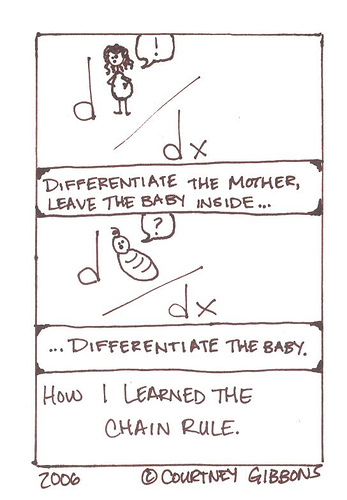
I love this comic by Courtney Gibbons on "How I learned the Chain Rule."  I showed it to my classes this year:


I never really liked using the terms "inside" and "outside" functions anyway.  Maybe because you can decompose functions in an infinite number of ways, and those terms, to me, imply that there is only one inside and one outside function possible.  I don't know.  Maybe I'm being too picky.  But, I kind of liked the mother/baby analogy.  And my kids LOVED it.  It's hilarious when someone walks in and my kids are muttering, "Ok, now differentiate the baby..."

But, in all honesty, here's what I really like about this comic...you can extend the idea, which is something you cannot do with the terms "inside" and "outside" functions.  Here's what I mean, let's say you have a function such as y=f(g(h(x))).  Now you have baby (h(x)), mom, (g(x)), and--you guessed it--grandma (f(x)).  The kids went wild the first time they heard this.  But, seriously, it works.

*****

I'm pretty sure I haven't posted this before, but here's a worksheet for practicing the chain rule.  My textbook doesn't have a lot of these types of problems (actually, I don't think it has any), but AP Calc students (well, I think all calc students...) need to learn to recognize that the chain rule is required to differentiate functions in the form of y=f(g(x)), even when f and and g are not explicitly defined.

It looks like there's four pages  here, but it's really just two (I print two pages to a sheet so that they'll fit in students' composition notebooks).  The second page  gives practice with functions defined by a table.

Here ya go!


*****
One more note on chain rule.  When we have a trig function raised to a power, such as y=sin^2(x), I encourage (read make) my students rewrite the function as y=[sin(x)]^2.  This makes it much easier for them to identify the mom (x^2) and the baby (sin(x)).  I try to start this habit in PreCalc so that it's second nature by the time they see it again in Calculus.

And that's that.  Chain rule...I'm getting a little better at it.  Slowly but surely.

Another Review...

I'm always trying to fine-tune review activities.  I used to be really into review games.  I would spend hours creating games that we'd play the day before a test.  They're fine:  I still use several of them.  But my criteria of what constitutes a good review has really simplified to two things:

  1. Students do most of the work/explaining (not the teacher)
  2. Students can self-correct their errors
These two objectives led me to a very simple review for my PreCalculus classes that I thought went swimmingly.

The kids were given a study guide to review for their Quarter Exam (kind of like the Quarter Quell...just kidding...sort of...).  The next day, they were to come to class with a note card with a question like one from their study guide but with different numbers and multiple choice. I didn't tell them which problem to work; I asked them to pick one that they felt they needed more practice on.  (Because if one student needs more work on an objective, then there will be other students who need help in that area also.) Additionally, they were asked to fill out this Google Form so that I could have a key to their questions without having to work fifty problems:


I took two days to let the kids work through all the problems (the first day they worked through their class's cards and the second day they worked through the other PreCalc class's cards).  I made slips of paper with the numbers 1-49 (each kid was assigned a number) so that they could keep a record of their answers (and I could grade them easily).  I made them go back and correct the ones they missed.

This was absolutely lovely because I really didn't have to do anything these two days.  Normally I walk around and take questions, but I wanted the kids to be answering their own questions.  If someone would try to ask me a question, I would tell them to ask the person who wrote the question.

This is the rubric I used:

Q2 MC Test Question Assignment (10 points)
2 points: Create a question like one from the study guide with at least medium difficulty

4 points:  Four good multiple-choice options:  one correct answer and three good distracters

1 point
: Index card formatted correctly:  assigned number on the top left, question with all four answers, name and hour on back

1 point:  Very clean handwriting

2 points:  Correct answer submitted on Google form (tinyurl.com/Q2multiplechoice) by tomorrow’s class


Things I really liked about this:
  • I didn't have to write any more problems.
  • Students got practice writing good multiple choice problems.
  • Students were the ones doing the work; not the teacher.
  • Students got lots of practice with the types of questions that they tend to struggle with.
The only thing I didn't like so much:
  • Some kids didn't have a correct answer on their card...but kids usually found the mistake on their own.
I really liked how this played out.  Super easy on the teacher's part, and kids got loads of practice.


Sunday, September 28, 2014

Formal Definition of the Derivative

Howdy, fellow AP Calc teachers!  You know those derivative questions on the AP exam that are disguised as limits?  Here's a worksheet to help students be able to recognize these questions and hopefully gain some fluency in moving from one form to the other.

I gave this before the kids learned any shortcut rules.  After they learned the rules, they filled in the answer column.

Sunday, September 21, 2014

Local Linearity

I haven't posted at all since school began over a month ago.  It frustrates me that the periods I do some really great work in the classroom (or at least, I think so) are also typically the periods I have zero free time and hence the best blog posts potentially go unwritten.

Le sigh.

Well, regardless, here's something we did in calc a couple weeks ago...

A big idea I want kids to come out of calc with is that if we zoom in on a differentiable function long enough then the function, no matter how "squiggly," will start to look like a line.  Why do we care?  Because lines are crazy easy to manipulate and make predictions from.  The key is, if we get too far away from our "zoom point," the line we came up with will no longer be useful to us.

To help kids grapple with this idea, I split them up into groups and gave them a function and an x-value.  They were to graph the function on their calculators and then zoom in on the given x-value until they felt the function looked like a line.  At that point, I asked them to find a few things:

  • The two end points of the line segment shown in their viewing window (using the TRACE feature)
  • The slope of the line using these two points
  • The local linearization (i.e., the equation of this line)
They were asked to do this for four different x-values.  Here are the slips of paper I cut up and gave each group:


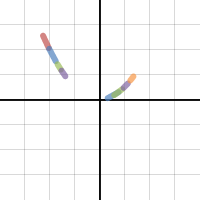
As they turned in their finished slips, I started to type in their lines (with restricted domains) into Desmos.  I couldn't type as fast as they were finishing, but this is one of the pictures we started to produce.

Hey guys...what function do you think these two groups had?  y=x^2?  You bet!  Could I have used that first red line for the whole function?  No?  Why not?

I think it really made sense to the kids.  In the future (NOW THAT DESMOS HAS A FREE APP!!!!!!!!!!!!), I think I will share a link with each group that has the same function and then THEY can type in their lines.  I'll have to show them how to restrict domains so I'll probably only have each group come up with two linearizations as opposed to four.

Here's the homework I made that went along with it.  Not sure the homework is much to write home about, but at the very least it gets the kids working with tables, which is a representation they need to be more comfortable with:

Tuesday, August 5, 2014

My Favorites {TMC14}

I hope everyone who did a My Favorites talk at TMC14 has blogged or will blog about it at some point.  I shared two favorites and wanted to document them here, for those who had any questions or for those who didn't get to attend this year...

#1:  Friday Letters

I stole this entirely from a middle school teacher (now assistant principal) in my district, Scott.  Every Friday, my kids have the choice to either do the warm-up on the board or write me a "Friday Letter" (a letter to me from them about anything they want to talk about).  In the beginning of the year, I remind them of this choice often.  When they enter the classroom, the board might look something like this:


At first, this is a pretty novel concept for most of the kids.  Plus, they get to get out of the warm-up, so most everyone writes a letter.  As the year progresses, I remind them less and less (and consequently fewer kids write).  However, I keep some promises:

  1. The mailbox will always be in the back of the room for you to put letters in.
  2. I will check the mailbox every Friday.
  3. I will personally respond to every letter I receive.


Yes, #3 can be daunting at times.  At first, I got a lot of letters that were mostly just, "Hey Mrs. P!  Hope to see you at the football game tonight!" or "What's your favorite Harry Potter book?"  And I had promised to respond to every letter, so I did.  But, as the year progressed, I received fewer of those kinds, and I mostly only got letters from kids who really enjoyed communicating through writing.  I would have kids write their letters at home on Thursday night so that they could put them in the mailbox on Friday (several letters were a full page, front-and-back).

I got funny letters and heart-breaking letters. Sincere letters and goofy letters.  But each letter gave me insight into a kid; insight that I wouldn't have gotten any other way.  I kept each letter in a big, green binder that I'll add to this year.

I found that my quietest (usually very successful) kids would have the most to say.  When I would check in with them in class and ask how things were going, they'd reply with a quick "Oh, I'm fine! No questions yet!"  But then I would get these novels from them in their Friday Letters.  It was a way for me to connect with kids that I really don't think I would have connected with otherwise, or--at least--not on that level.


Some people asked me how I would respond to the letters.  You know those yellow legal pads of paper?  You can buy them in a smaller size (5"x8"), and that's what I used to write return letters.  I tried to fill at least the front side half-way.  Sometimes, though, I would fill both front and back fully...depending on how much the student had to say and how much I had to say in return.


#2:  Mathematician Spotlight


I've actually blogged about this before here and here.  This is a way I incorporate a little (emphasis on little) history and language arts into my PreCalc classes (though I think this could be done at just about any level for middle school, high school, and college students).  Essentially, my kids research a mathematician for some extra credit for each unit test.  Last year I also gave them a quote by the mathematician and had them defend or dispute the quote.  I think this year I will have them find a quote on their own, instead of giving one to them.

I made a new sign for this year (above).  Feel free to print and use it if you'd like (click here to download).